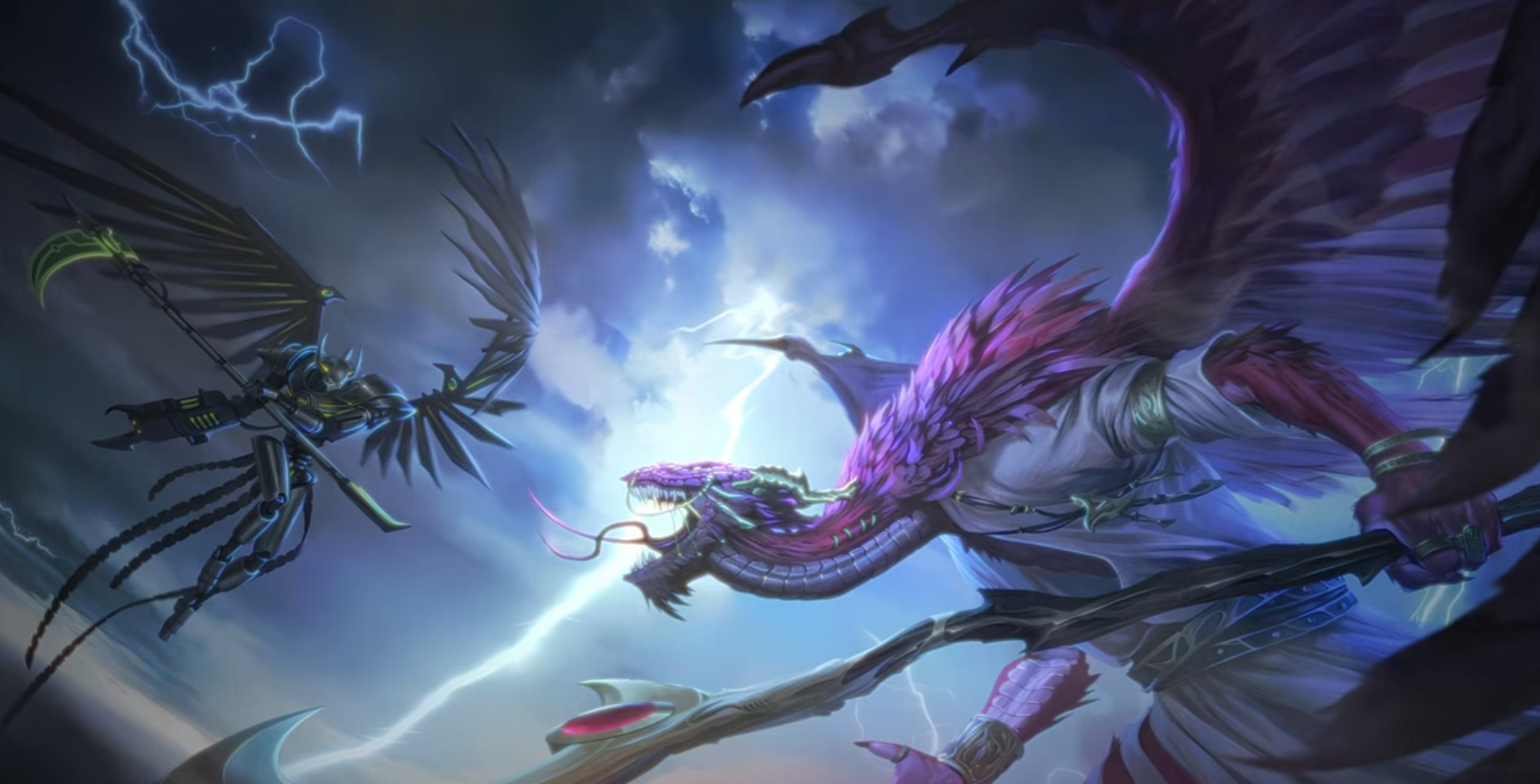

Introduction: Embracing the Madness of Change
What is the true cost of ambition? How far would you go for forbidden knowledge or the power to reshape your destiny? In the grim darkness of the 41st Millennium, these questions are not merely philosophical—they are invitations. They are the whispers of Tzeentch, the Chaos God of Change, Evolution, and Sorcery, who embodies the ultimate paradox of existence.
Known as the Changer of Ways and the Architect of Fate, Tzeentch is a being of pure contradiction, weaving intricate plots that span millennia for purposes even he may not fully comprehend. To understand him is to flirt with madness. This article will distill the sprawling lore into five of the most surprising and counter-intuitive truths about this master of manipulation, revealing the profound insanity at the heart of the Great Game.
1. The God Who Can’t Win… On Purpose
The central paradox of Tzeentch is that his ultimate goal is not victory but the continuation of change itself. While he tirelessly schemes to assert his superiority over the other Chaos Gods and the galaxy at large, he can never allow himself to achieve a final, decisive win.
If Tzeentch were to attain total supremacy, the universe would enter a state of finality. This static outcome is the antithesis of his very nature; for change to end would be for Tzeentch to end. Consequently, should he ever approach absolute victory, he would immediately sabotage his own success to ensure the Great Game continues. This self-defeat is not just a conscious act, but an inherent trait; the source material notes that “at times the very complexity of his designs brings them to ruin.” His nature is to weave plots so intricate that they are destined to unravel, ensuring no final knot is ever tied. This subverts the typical villain archetype, framing Tzeentch less as a conqueror and more as an eternal, cosmic force whose schemes are an end in themselves, not a means to one.
he is incapable of achieving a result that could be called complete for that would signify the ending of the path and consequently the end of his existence.
2. You’re Not His Follower, You’re His Fuel
Mortals who turn to the Changer of Ways believe they are entering a “mutually beneficial pact,” trading servitude for arcane knowledge. The horrifying truth is that they are not partners; they are an infinitesimal fraction of his sustenance. Tzeentch doesn’t just feed on his cultists—he feeds on the very concept of hope and ambition throughout the cosmos.
His power is drawn from the yearning for transformation that “dwells in every creature from the first division of cells to the fierce urge to survive.” In his mind reverberate the hopes of every living being, from the lowest dregs of society to the highest echelons of power. “Imperial governors and fleet admirals likewise dream of wealth and dominion,” and their grand ambitions provide the same psychic nourishment as the back-alley rituals of a hidden cult. Tzeentch observes the dreams of his “play things,” granting success or doom not for their benefit, but for his own “unfathomable ends or merely for amusement.” Whether an ambition is realized or crushed, the raw emotional energy of that change simply feeds his boundless power, making him an insidious, omnipresent threat woven into the very fabric of life itself.
3. To Describe Him Is to Fall into His Trap
Attempting to define the physical form of Tzeentch is an exercise in futility. Accounts are wildly contradictory, describing him as a gaunt sorcerer whose skin is “studded with distorted faces and mouths whispering secret or terrifying words that immediately contradict themselves,” or as “ugly birds, fish, or perverse hybrids of both.” At other times, he is a formless cloud of multicolored smoke or a writhing mass of ever-changing flesh.
Any perceived pattern is a deliberate deception. The Architect of Fate understands that to define something is to limit it, and he is a being of limitless possibility. The very act of seeking his “true form” is to lose his game, for even if you could comprehend it, the lore states that “in the next instant that nature would change rendering that apprehension obsolete.” The most faithful accounts of Tzeentch are, paradoxically, those that explicitly acknowledge their own imprecision and the high probability that they are yet another manipulation.
to attempt to know the true form of the master of mutations is tantamount to embracing madness since any description of Tzeentch is doomed to be inaccurate and may itself be a manipulation of the great deceiver.
4. His Minions are Matryoshka Dolls of Misery
Nothing encapsulates Tzeentch’s nature quite like the bizarre lifecycle of his most numerous lesser daemons, the Horrors. These creatures are living embodiments of endless, ironic transformation.
- Pink Horrors: The cycle begins with these gibbering creatures, whirling across the battlefield in “frenzied almost uncontrollable ecstasy” and laughing “madly at their own jokes which mean nothing to anyone else.” They gleefully hurl bolts of mutating warp-flame, a substance that doesn’t just burn but horribly transforms its victims into “statues of screaming glass” or “swarms of butterflies that congeal into human faces twisted with agony.”
- Blue Horrors: When a Pink Horror is slain, it doesn’t die. It splits into two smaller Blue Horrors. In a perfect Tzeentchian inversion, their temperament is the complete opposite. They are “sullen, tearful, and aggressive, like spiteful children,” their faces “twisted into daer grimaces” as they grumble and complain.
- Brimstone Horrors: If a Blue Horror is killed, it too divides, creating two tiny, blazing yellow Brimstone Horrors. These final forms are described as “globules of pure malice and bitterness,” tiny daemons consumed by a spiteful need to incinerate everything around them.
This strange process is a perfect metaphor for Tzeentch’s domain: nothing truly ends. It is simply, and often ironically, inverted and changed into something new.
5. The Tragic Irony of the Thousand Sons
The story of Tzeentch’s favored traitor legion, the Thousand Sons, is the ultimate Tzeentchian tragedy. This entire saga showcases the Architect of Fate’s preferred method: not direct assault, but the subtle manipulation of hope, pride, and desperation.
The tragedy began when their Primarch, Magnus the Red, discovered Horus’s betrayal. In an attempt to warn the Emperor, he used forbidden sorcery, shattering Imperial psychic wards. The Emperor, believing it a chaotic trick, refused the warning and, manipulated by Horus, dispatched Leman Russ and the Space Wolves not to arrest Magnus, but to raze his home world of Prospero.
Driven into Tzeentch’s embrace to survive, the Thousand Sons fled to the Planet of the Sorcerers. There, the “flesh change”—a plague of physical mutation they were already cursed with—began to spread anew. In a desperate act to save his legion, Chief Librarian Ahriman enacted a powerful spell, the Rubric of Ahriman. The outcome was a devastating irony: the spell halted the mutations for the legion’s powerful sorcerers but turned every non-psyker battle-brother into dust, their souls permanently sealed inside their power armor as mindless Rubric Marines. The quest to halt change resulted in an even more horrific and permanent transformation, proving that even Tzeentch’s greatest champions are merely pawns in his unending game.
The Unending Game
Tzeentch is not a god of conquest but of conspiracy; not of victory, but of the intricate and endless process of scheming. His followers are his fuel, his form is a lie, and his greatest triumphs are often acts of self-sabotage designed to keep the cosmic game in motion. He is the ultimate paradox, representing both the boundless potential of evolution and the hollow futility of ambition in a universe governed by cruel and unfathomable forces.
In a galaxy defined by brutal stasis and decay, is the maddening promise of change—no matter the cost—the most dangerous hope of all?

Leave a Reply